

Expanding transparency and accountability of investment funds through biodiversity metrics
Client

The eco.business Fund aims to develop a wide range of economic activities while supporting biodiversity conservation and climate change mitigation and adaptation in Latin America and Africa. Although the Fund has long monitored biodiversity outcomes, past measures offered only a partial view of impact. To strengthen investment decision-making and reporting, the Fund needed a unified, science-based approach.
About
At the intersection of finance and sustainability, the eco.business Fund is working on generating economic value, while contributing to biodiversity conservation and climate change adaptation and mitigation. The Fund focusses its investments into sectors such as agriculture, fishery and forestry, in both Latin America and Africa. Guided by international frameworks like the United Nations Sustainable Development Goals, the IFC Performance Standards, the Operating Principles for Impact Management and the Finance for Biodiversity Pledge, the Fund’s work is rooted in generating positive impact, striving to align financial activities with long-term sustainability, and transparent accountability.
Challenge
From the beginning, the eco.business Fund (EBF) has given great value to measuring the impact of its investments on biodiversity, with indicators such as hectares protected for biodiversity or safeguarded from deforestation, among others. While these figures provide important insights, the Fund was looking for a stronger framework for investment decisions and reporting. That is why the Fund set out to create a science-based single biodiversity metric that could bring these different dimensions together in line with its investment strategy and data availability. At the same time, with new frameworks and regulations for biodiversity assessment developing quickly, this metric needed to fit within relevant international standards and prepare it for future reporting requirements.
Solution
PRé developed an EBF-specific biodiversity metric building on its eligibility criteria for investments, its existing impact methodologies and the Biodiversity Footprint for Financial Institutions (BFFI) framework. The tool was developed to reflect the Fund’s portfolio across countries and crops as of 2023, enabling EBF to assess how its promoted sustainable practices contribute to reducing biodiversity loss.
Developing an impact measurement methodology to capture the EBF context
All activities financed by EBF share a common trait: they go beyond conventional production practices, seeking to reduce their impact on nature. For the Fund to invest, there must be a clear improvement in sustainability compared to traditional methods. This can stem from having an eligible sustainable certification in place (e.g., Rainforest Alliance), or from the implementation of individual sustainable practices eligible for investment (e.g., dry- instead of wet-cleaning of sugar cane, or the adoption of agroforestry practices).
These practice-based improvements were converted into measurable changes across the supply chain of each activity. Since the BFFI relies on a life cycle assessment (LCA) approach using ReCiPe (2016), these changes could be directly translated into impacts on biodiversity in terms of the potential damage to different types of species.
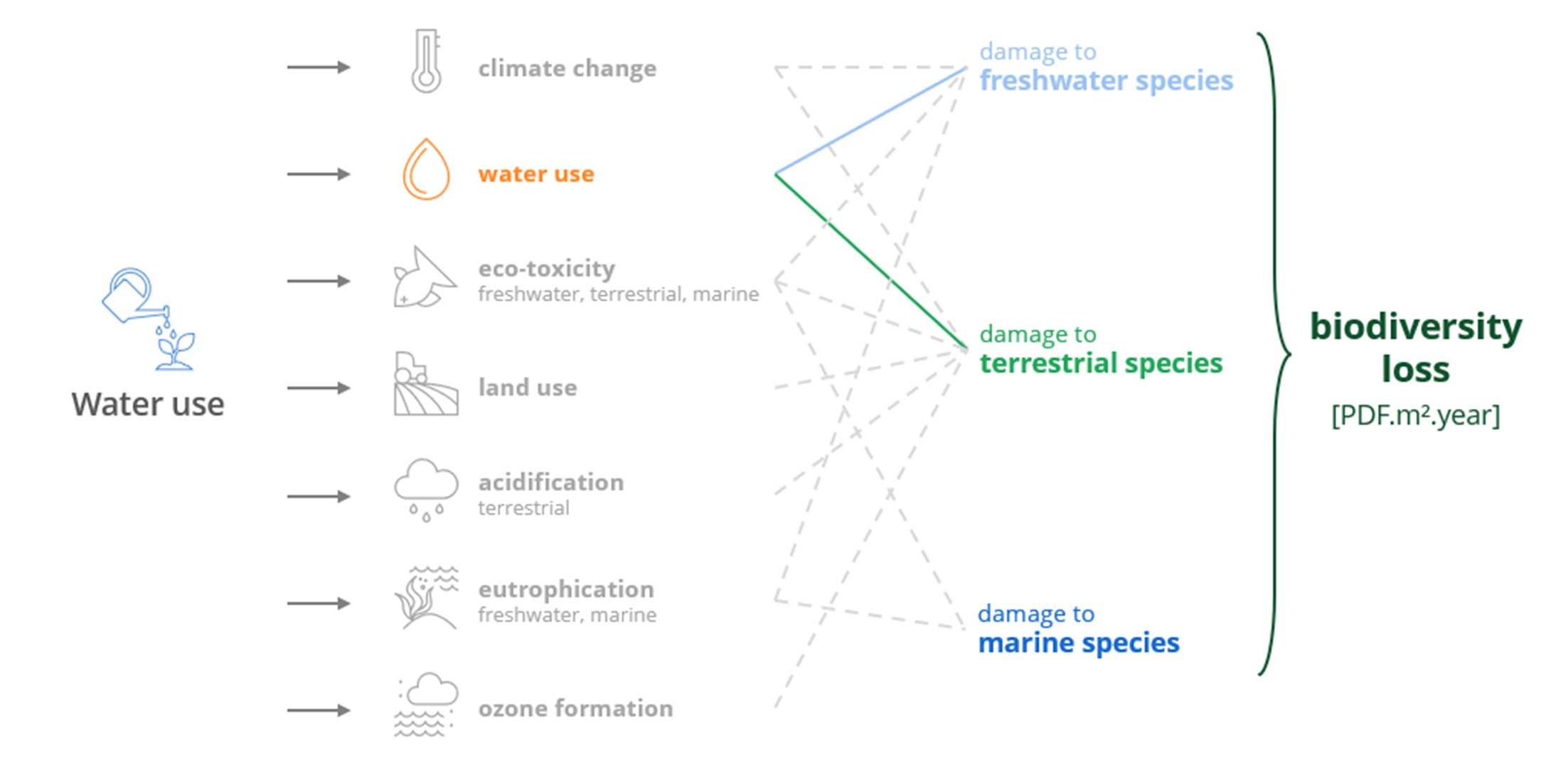
The results are expressed in terms of the Potentially Disappeared Fraction (PDF) of species—a metric that indicates the fraction of species that could potentially be lost in a specific area due to human activities. This metric is presented on a 0 to 1 scale, where 0 means all species are at risk of disappearing and 1 means no species are at risk.
As an example, let us consider the methodology of dry-cleaning sugarcane. This practice is estimated to eliminate water use for cleaning compared with conventional wet cleaning. By applying the BFFI framework, this reduction in water consumption can be directly translated into a quantified biodiversity impact, allowing EBF to evaluate the environmental benefits of its investment more clearly.
As part of the methodological development, we chose the term of avoided impact, mainly due to the lack of a universally agreed definition of “positive impact” and limited environmental data. This may be conservative, as the methodology only included clearly measurable interventions, so certain beneficial effects of EBF are not fully captured yet.
Tool development: How to make the results accessible?
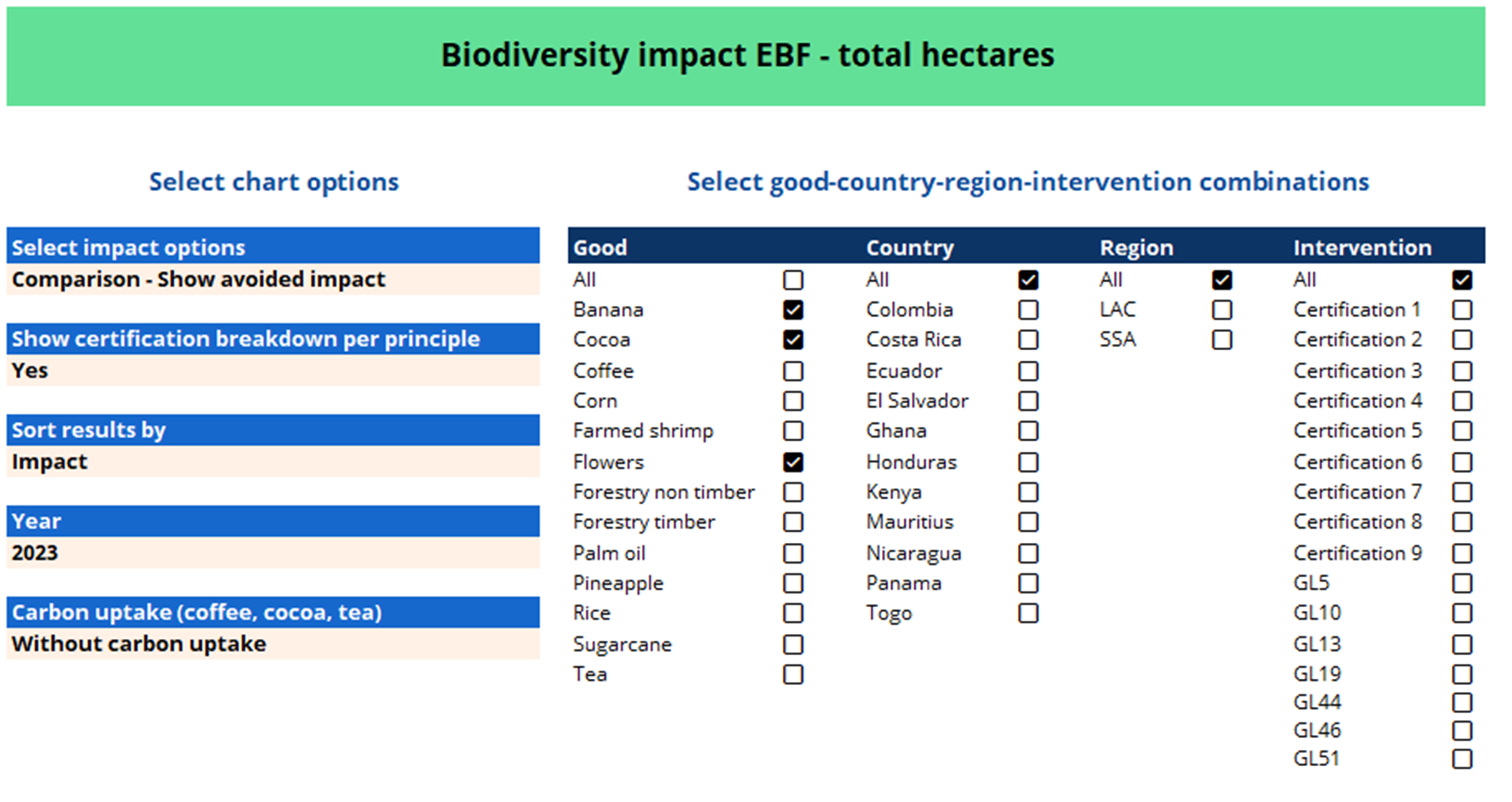
Once the metric was developed and applied across the EBF portfolio in SimaPro, the LCA-based results were compiled into a user-friendly Excel-based tool. This tool reports avoided impact in terms of PDF.m².year for each activity in the portfolio.
A key feature of the tool is its flexibility: it allows EBF to filter results by country, activity, year, or management practice, while also splitting the results by impact category, across different dimensions, making it easy to explore and compare biodiversity impacts. The tool also allows EBF to track progress over time, as it can compare performance across different years based on changing portfolio compositions.
Benefits
By integrating this science-based approach into its sustainability framework, EBF gains a clearer understanding of how its financing influences nature. As more granular and site-specific data becomes available—both from borrowers and within LCA databases—there will be greater opportunities to refine the methodology. This will not only improve its accuracy but also expand the range of sustainability benefits that can be captured and attributed to the Fund’s support.
These advancements will strengthen the Fund’s ability to track progress, demonstrate impact, and contribute meaningfully to more nature-aligned finance.

Working with the PRé Sustainability team was a truly positive experience. The team demonstrated a high level of professionalism and quickly immersed themselves in understanding the eco.business Fund’s mission, investment strategy, and impact framework. Their ability to grasp the nuances of our work and translate them into meaningful insights was impressive. We are pleased with the results and believe this piece of work contribute to advancing the broader conversation in sustainable finance, particularly around how to effectively measure impact in biodiversity.
Daniel Castro, Manager Impact at Finance in Motion
Contact the expert
Ana Judith Esquivel
Analyst