

Helping shape Europe’s harmonized environmental footprint rules for the space sector
Client

Europe's space industry delivers broadband, Earth observation, and navigation services to billions of people. Until recently there was no harmonized way to measure its environmental footprint. Commissioned by the European Commission's DG DEFIS, the PEFCR4Space project is developing environmental footprint rules for the space sector, giving companies, regulators, and investors a common, science-based basis for comparison. As part of the consortium, PRé is contributing life cycle assessment expertise to help turn that ambition into a workable standard.
About
Space is no longer solely the domain of national space agencies. Thousands of satellites now circle the Earth, delivering broadband internet, Earth observation data, weather forecasts and navigation signals to billions of people. As the sector scales rapidly so does its environmental footprint, from satellite manufacturing and launch to in-orbit operations and end-of-life deorbiting and debris.
To address this, the European Commission’s Directorate-General for Defence Industry and Space (DG DEFIS) commissioned a multi-year project to develop Product Environmental Footprint Category Rules (PEFCR) for the space sector, known as PEFCR4Space. The project is coordinated by a consortium including PRé Sustainability, VITO, NovaSpace, Ecomatters, Ecoinnovazione, and Glasgow Caledonian University, all subject-matter experts in LCA and the space sector.
Challenge
Unlike sectors such as apparel or food, where products are relatively easy to compare, the space sector spans an enormous range of very different and complex products and services: launch vehicles, broadband and narrowband satellite connectivity, Earth observation, positioning and navigation, and ground infrastructure. Supply chains are complex, materials are highly specialized, lead-times are lengthy – and until now there has been no consistent, science-based way to assess or compare environmental impacts of the products delivering the service in a harmonized way, considering the entire life cycle.
Quick guide: what’s a PEFCR?
Product Environmental Footprint Category Rules are based on the European Environmental Footprint (EF) methods and define exactly how to calculate and communicate the life cycle environmental impacts of a specific product category, so that different companies’ results are calculated the same way and can be fairly compared.
This diversity made scoping the rules one of the project’s early challenges. The rules need to be robust enough to cover the whole sector, yet specific enough to stay meaningful, without multiplying sub-categories to the point of impracticality.
Solution
The PEFCR4Space project consists of three main work packages (WP):
- WP1 Development of the PEFCR for EU Space Sector
- WP2 Dataset Development
- WP3 Stakeholder Engagement
As part of the consortium, PRé Sustainability is contributing our in-depth life cycle assessment (LCA) and PEFCR expertise to the technical development of the draft rules across all six sub-categories in scope: Earth observation services, positioning, navigation and timing (PNT), satellite video services, satellite connectivity services, in-space transport services, and uncrewed launch services from Earth to space.
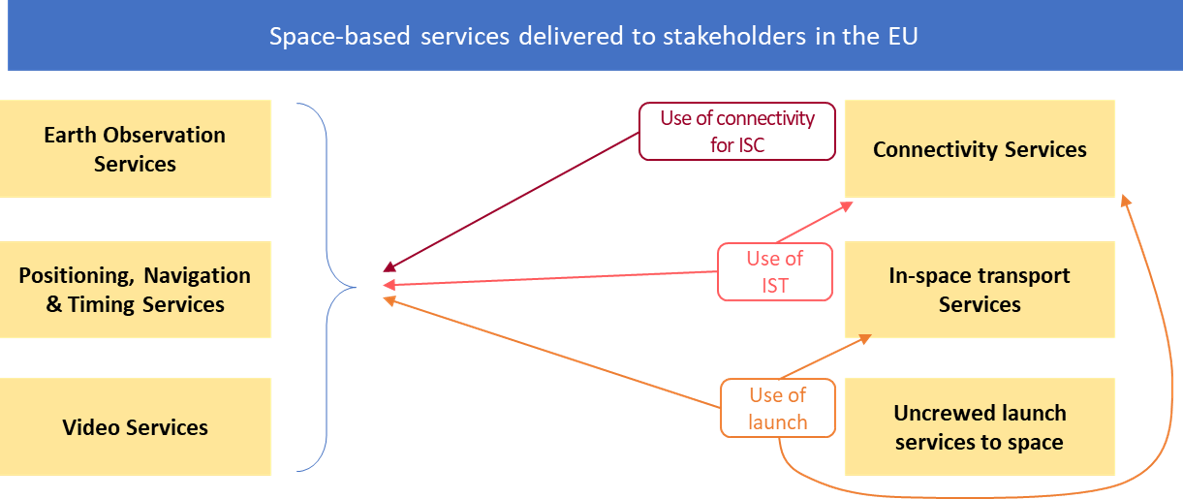
If a service falls outside those six subcategories, the horizontal rules may still be applied to carry out the assessment. However, comparability cannot be guaranteed in this case, since a specific common functional unit would be needed.
This fact points already to one central challenge: defining functional units and system boundaries that are specific enough to produce meaningful, comparable results, while staying consistent with the overarching EU Product Environmental Footprint (PEF) methodology. In practice, this means setting separate system boundaries for spacecraft and for launchers, since these entail entirely different manufacturing processes, materials and life cycle stages.
We worked through these scoping questions case by case for each sub-category, developing non-substitutability arguments to justify why certain services cannot share a single functional unit, and grounding our assumptions in real technical data on representative products and operators wherever primary data wasn’t yet available. This groundwork helped ensure the rules are specific enough to be usable in practice by companies across very different parts of the space value chain, from launch providers and satellite operators to ground segment services.
Benefits
This groundwork fed directly into the first draft of PEFCR4Space, which went into the first public consultation between October and December 2025, inviting space companies, researchers and other stakeholders to test and refine the rules. Supporting studies with volunteer companies are now underway to validate whether the draft methodology works in practice, ahead of a final PEFCR expected around 2027.
For the space sector, this matters because it creates a common, scientifically credible language for environmental performance: one that makes sustainability claims verifiable rather than aspirational, and gives operators, investors and regulators a reliable basis for comparison. As demand for satellite connectivity, Earth observation and navigation keeps growing, PEFCR4Space is laying the groundwork for a sector that can prove its environmental credentials as rigorously as any consumer product industry already does.
Contact the expert
An De Schryver
Sector Lead Space