

Test and recommend improvements to the draft Apparel and Footwear PEFCR
Client

Apparel and footwear production takes place all over the world. Therefore, the sustainable challenges that the industry faces require collective action on a global scale. Environmental footprinting of apparel and footwear products is a piece of the puzzle. The demand for environmental information in the sector is increasing, alongside changing consumer preferences, increased pressure from retailers, supply chain partners and investors, and new local and international regulations to comply with.
About
At PRé, we often compare successful environmental footprinting to cooking up a good meal (check out our article which illustrates this). One key element is the recipe – this tells you which ingredients you need and how much, when to add ingredients to your taste, and the steps to follow. In environmental footprinting, this is the footprint methodology. Ideally, you want a methodology that’s as specific as possible to your product or organization, to ensure that your results can be compared to the calculations of other organizations in your sector.
The European Commission’s Environmental Footprint initiative coordinated by the European Commission aims at the development of product-category specific footprint methodologies that follow the specific PEF method requirements i.e. of Product Environmental Footprint Category Rules (PEFCRs). The apparel and footwear industry saw this as an opportunity to further align on how different parties measure the environmental performance of these apparel and footwear products. So, they applied to jointly create a recipe for environmental footprinting of products within the sector.
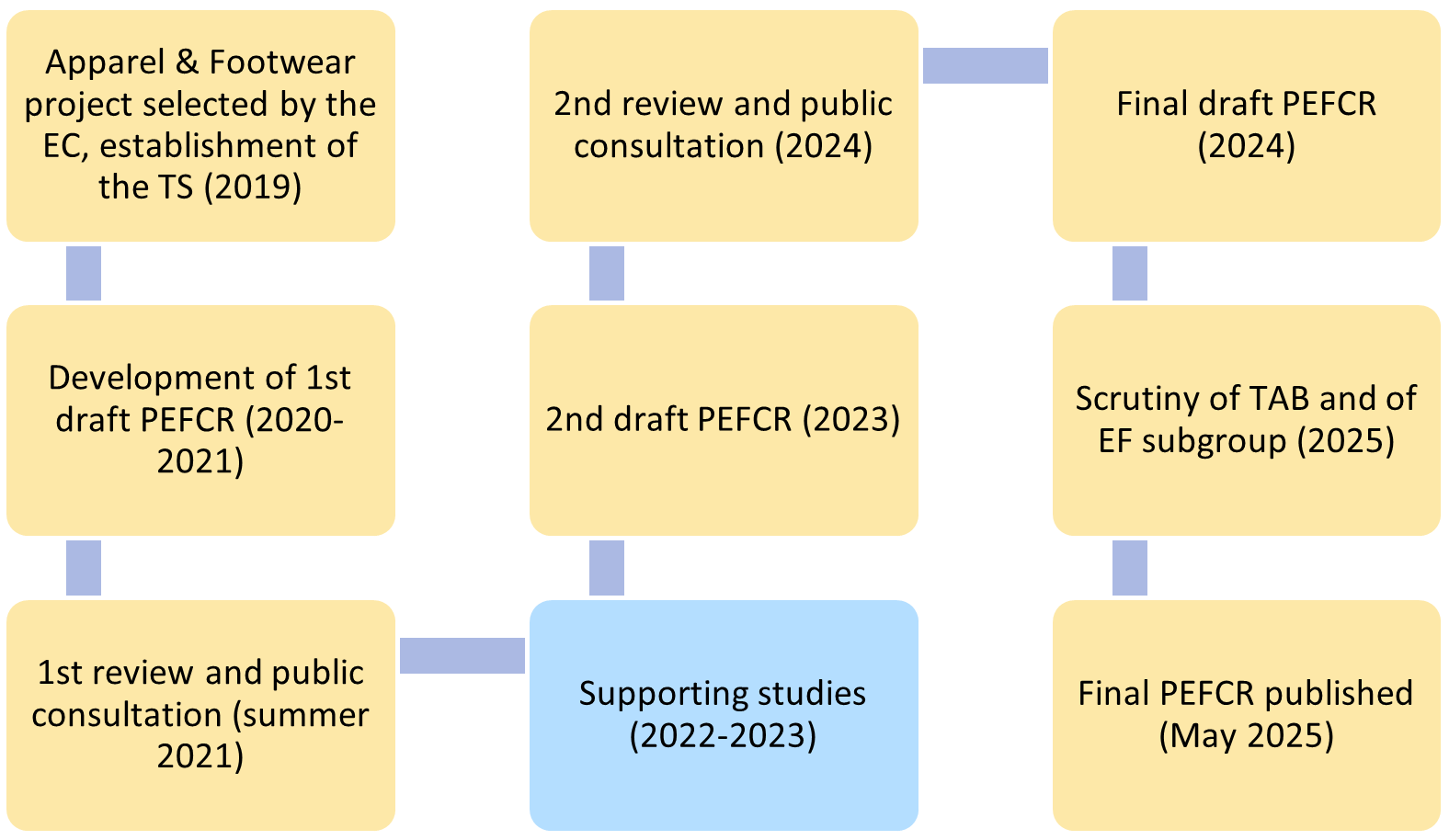
In 2019, the EC approved a PEFCR for apparel and footwear products to be developed during the Environmental Footprint (EF) transition phase, and the Technical Secretariat (TS), led by Cascale (formerly Sustainable Apparel Coalition), was established. This marked the start of the development of the Apparel and Footwear PEFCR, which was finally concluded in May 2025. The process of which is illustrated below.
Challenge
As part of this 5+ year project, the TS of the Apparel and Footwear PEFCR project commissioned PRé as an LCA expert partner to help them carry out 14 supporting studies (13 different brands across 13 product categories). The supporting studies are where it becomes clear if the methodology can also be used in practice and at reasonable costs by the members. In other words, the proof of the pudding is in the eating.
The goal of the supporting studies is to test how easy it is to implement the first draft PEFCR and, to a lesser extent, provide indications about the suitability of the impact categories, life cycle stages, processes and direct elementary flows identified as most relevant.
Our overarching aim was to present the TS with a detailed account of feedback and recommendations, including a clear overview of the most important overarching themes.
Solution
PEF studies are typically highly resource- and time-intensive, so conducting the 14 supporting studies required an efficient and modular approach, illustrated below. In supporting studies, the five steps outlined in PEF are required: goal and scope definition, life cycle inventory, life cycle impact assessment, and interpretation. All supporting studies were submitted to and validated by the external independent review panel. This truly allowed us to learn while doing, while collating the feedback and recommendations.
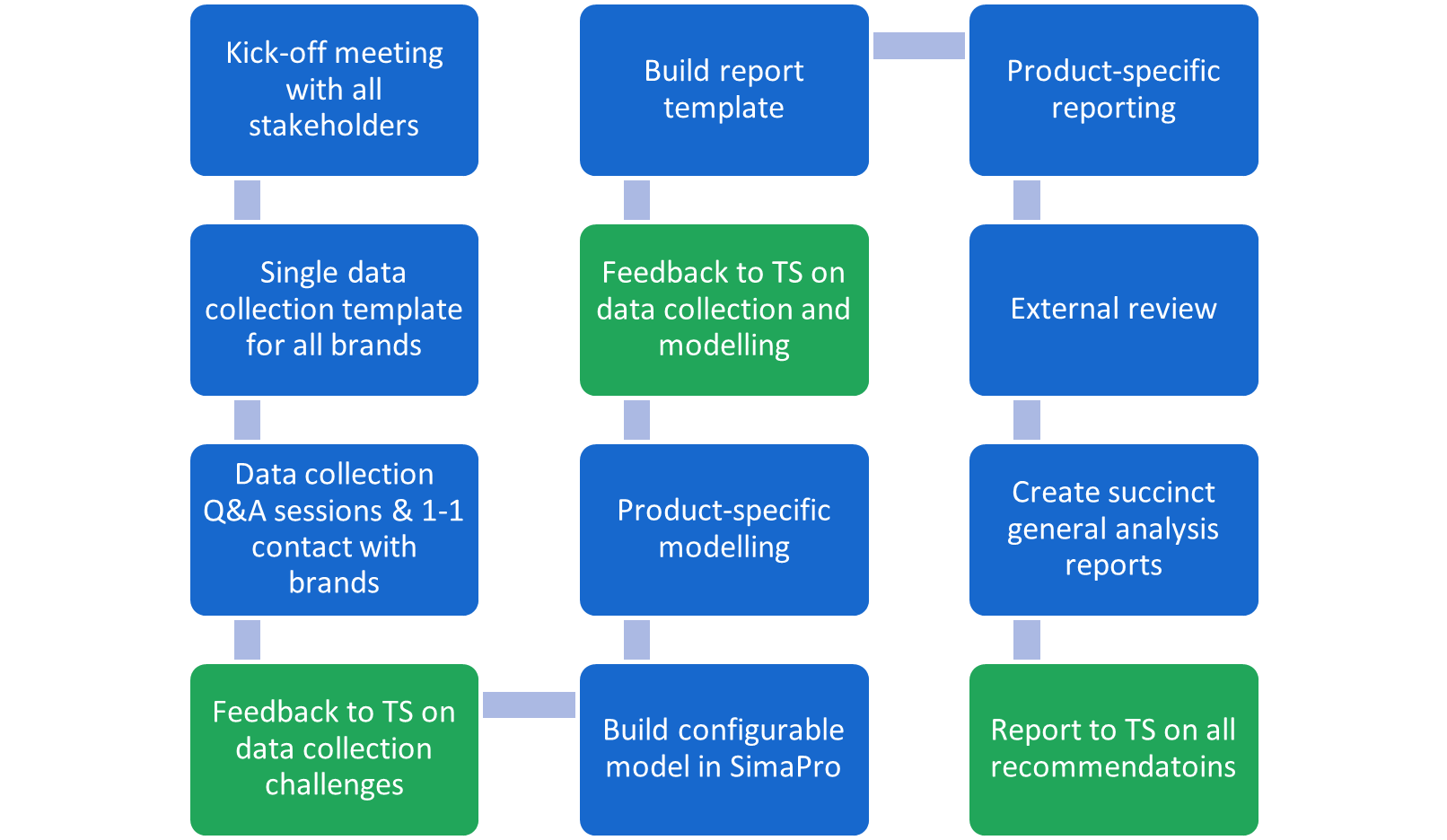
To streamline the process, we created a configurable model. This is like doing all the chopping and dicing ahead of time in our cooking metaphor. With this configurable model, we only needed to model the life cycle stages once, configuring the default rules for distribution, storage, retail, use stage, and end-of-life. These building blocks were used as the starting point for all product-specific models, enabling efficient modelling.
Throughout this process, the substantial benefit of employing configurable models showed itself again and again. These models are critical for being able to scale footprinting efforts, and provide a streamlined and efficient approach to LCA. However, in our experience, these models still needed to be integrated with tailored LCA craftsmanship to achieve the best outcomes. In some parts of the process, we used a “manual” approach which helped maintain quality and attention to detail, for several reasons:
- A key purpose of the supporting studies is to identify gaps and points of improvement in the PEFCR. A hands-on approach meant we were more attuned to the finer details and faced these challenges head-on.
- The PEFCR modelling methodology was still under development, so case-by-case decisions were occasionally required.
- The apparel and footwear value chain is highly diverse and complex, which means company-specific data often doesn’t fit into a generic module. With improvement over time, configurable models will eventually be able to support the variety of product and company-specific characteristics while not compromising on precision.
Ultimately, configurable models represent the backbone of future scalable yet reliable LCA systems. By continuously improving these models and integrating them with expert craftsmanship, we can ensure both the precision and adaptability needed to meet the challenges of this dynamic field.
Benefits
The process of doing the supporting studies proved highly successful, revealing important methodological gaps and improvement opportunities. In total, we submitted over 180 individual feedback and recommendation points to the TS. These informed the 2nd draft PEFCR, released for public consultation in early 2024. As a bonus, the 13 brands involved in the supporting studies gained meaningful insights into the environmental footprint of one of their main products.
The PEFCR is an important element for the robustness and scalability of footprinting within the apparel and footwear sector. With the PEFCR now receiving the green light from the European Commission, we hope it will become the sector’s favorite recipe for footprinting. Ultimately, the goal is for brands, consumers, supply chain partners and investors to have reliable insights that serve as a solid basis for comparison. With the configurable models, we also hope to contribute to reducing the time and resources required for each footprint, which will help with adoption of the process and meeting the growing need for environmental information.
The combination of a well-defined recipe and configurable models will help empower a variety of users to generate high-quality, consistent results while flexibly addressing unique challenges. We’re looking forward to seeing the Apparel and Footwear LCA kitchen coming together.

The Apparel and Footwear Technical Secretariat received the support of PRé Sustainability during the testing of an initial version of its PEFCR. Their support was not only extremely professional and qualitative, but the team of PRé Sustainability went beyond and provided very valuable recommendations and insight that enabled us to strengthen our PEFCR. We are very happy to have selected them and to have received their support on this project.
Baptiste Carriere-Pradal, Co-founder and director at 2B Policy
Contact the expert
Ellie Williams
Sector Lead Food & Beverage