

CSDDD applies from 2029: how to start your due diligence process today
Human rights due diligence has become a core business expectation for any company with an international value chain. Investors ask about it, NGOs scrutinize it publicly, and the EU's Corporate Sustainability Due Diligence Directive (CSDDD) turns it into a legal duty for the largest companies from July 2029, with expectations flowing down to the suppliers they work with. Companies that start now will have a credible, tested process in place when it counts. Here's a practical way to begin.
A practical way to assess human rights impacts across your value chain
In September 2026, the inaugural UN Business and Human Rights Regional Forum in Western Europe brought together a broad range of stakeholders to strengthen business practices and connect on how businesses manage value chains across our region.
Several speakers stressed that lighter legal obligations don’t lower society’s expectations of companies. There was a call to evaluate due diligence by its effectiveness, including the quality of companies’ risk assessment and impact measurement, rather than by the effort put in.
Most companies don’t know where to start with assessing human rights.
Organizations with international value chains are being watched more closely than ever on how they handle human rights risks. NGOs scrutinize sustainability due diligence processes publicly, sometimes triggering lawsuits, investors ask about it directly and regulators, through for example the EU’s Corporate Sustainability Due Diligence Directive (CSDDD) and Corporate Sustainability Reporting Directive (CSRD), are turning it into a binding legal obligation for companies above a certain size, with more countries in Europe and Asia-Pacific following suit.
The trajectory is clear even when the details keep shifting. In February 2026, the EU’s Omnibus I package narrowed the CSDDD’s scope considerably: it now applies to EU companies with more than 5,000 employees and over €1.5 billion in net worldwide turnover, and to non-EU companies with over €1.5 billion in EU turnover, well above the original thresholds, with application from July 2029.
Fewer companies are directly in scope, but the core duty for those that remain, to identify, prevent and address adverse impacts, still stands. Pressure still flows down through value chains to smaller suppliers and partners regardless of where the legal line sits. Waiting to see where regulation lands is simply not enough to be prepared for a forward-moving regulation such as the CSDDD.
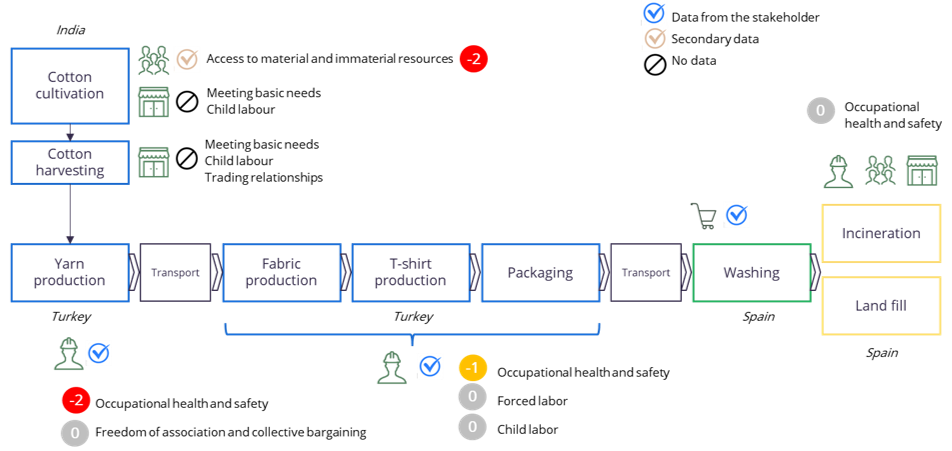
Resulting scores from a Social Value Assessment
The real obstacle isn’t willingness. It’s method.
The UN Guiding Principles on Business and Human Rights and the OECD Guidelines for Multinational Enterprises set out what a due diligence process should achieve, but neither prescribes a standard methodology for the assessment itself. That gap, more than any lack of intent, is why so many due diligence programs stall at exactly this step.
It’s a genuinely hard problem to solve alone. There’s limited pre-existing data on social impacts, few tools built specifically for it, and no shortage of high-level frameworks that stop short of anything an organization can actually run internally. Building a credible, defensible assessment methodology from scratch takes years most compliance teams don’t have, especially with a 2029 application date that feels close once the internal build-out is accounted for.
This is where PRé can help
PRé Sustainability, the team behind SimaPro, has spent over a decade solving exactly this problem alongside around two dozen industry partners, including BASF, LG Chem, Corbion, and Fuji Oil, through the Social Value Initiative.
The result is the Social Value Assessment (SVA) methodology: a consensus-built, sector-agnostic approach to identifying and scoring human rights and social impacts across an entire value chain, already proven across multiple industries and case studies.
Our white paper on human rights due diligence
Our white paper is an introduction to human rights due diligence using a lifecycle thinking approach. It gives practical advice on how to follow human rights due diligence assessment processes to incorporate these into regular business practice.
What that means in practice for a company starting, or restarting, its due diligence process:
- A defined scope, definitions of stakeholder groups, social topics and indicators aligned with the ESRS standards behind CSRD reporting give you a standardized starting point instead of building topic definitions internally from zero.
- A way to prioritize, not just list, risks: a materiality and saliency assessment narrows a long list of possible topics down to the ones that actually matter for your value chain, scored on how severe, how widespread, and how reversible each risk is.
- A defensible score, not a gut feeling: a five-point reference scale, now enhanced with the “type of contribution” concept from the UN Guiding Principles, which the CSDDD reflects (whether your organization caused, contributed to, or is directly linked to an impact), gives you a due diligence score that points directly at what action is appropriate and why.
Not sure where your due diligence process stands today? PRé’s team can help you scope a first assessment against your own value chain.
Read or download our white paper below for the full method, or get in touch to talk it through with our team.
Shaniq Pillay
Expert
Coming from the Global South has given me unique exposure to sustainability as an enabler for development and its complex interactions with environmental and economic progress. I think it is our duty as sustainability professionals to ensure that the decisions consumers and companies make are well-informed and account for their social and environmental implications throughout the supply chain.