

From damage control to sustainable innovation: the Safe and Sustainable by Design (SSbD) journey
Chemicals and advanced materials can power innovation, but they can also create long-lasting risks. The European Commission’s Safe and Sustainable by Design (SSbD) framework encourages a proactive approach, guiding innovators to embed safety and sustainability at the earliest stages of product development. By integrating life cycle thinking and structured assessments, SSbD helps companies minimize environmental and health-related risks, future-proof innovation, and align with the EU’s green transition goals.
Why a proactive approach is essential
While chemicals and advanced materials can fuel innovation and contribute to progress, they can also carry risks. Substances of concern can cause lasting harm to human health and ecosystems, especially when safety and sustainability are addressed too late in the design process. By then, harmful properties are often baked in, resulting in greater health risks, environmental damage, and regulatory burdens. To drive low-impact innovation, a shift from a reactive to a proactive approach is needed.
In 2022, the European Commission announced a voluntary approach to guide the innovation process for chemicals and materials at an earlier design stage, namely the ‘Safe and Sustainable by Design’ framework (SSbD), published as a voluntary Commission Recommendation.
The SSbD aims at three main goals:
- Steer the innovation process towards the green and sustainable industrial transition.
- Substitute or minimize the production and use of substances of concern, in line with and beyond existing and upcoming regulatory obligations.
- Minimize the impact on health, climate, and the environment during sourcing, production, use, and end-of-life of chemicals, materials and products.
In short, the SSbD aims to support the transition towards safer and more sustainable chemicals and materials at early design.
The steps of SSdB
The framework is composed of a (re-)design phase and an assessment phase (5 assessments) that are applied iteratively as data becomes available. The SSbD applies life-cycle thinking in each assessment step:
- Hazard assessment – Evaluates the intrinsic risks of hazards of the innovation.
- Human Health and Safety assessment – Examines exposure and potential harm during production and processing on the workers.
- Human health and Environmental safety assessment – Focuses on the exposure and potential harm of the innovation during its use and on ecosystems.
- Environmental impact assessment – Measures the environmental footprint via LCA, recommending the use of the Product Environmental Footprint (PEF) methodology and method.
- Socio-economic impact assessment – Optional step which considers social and economic factors alongside environmental performance.
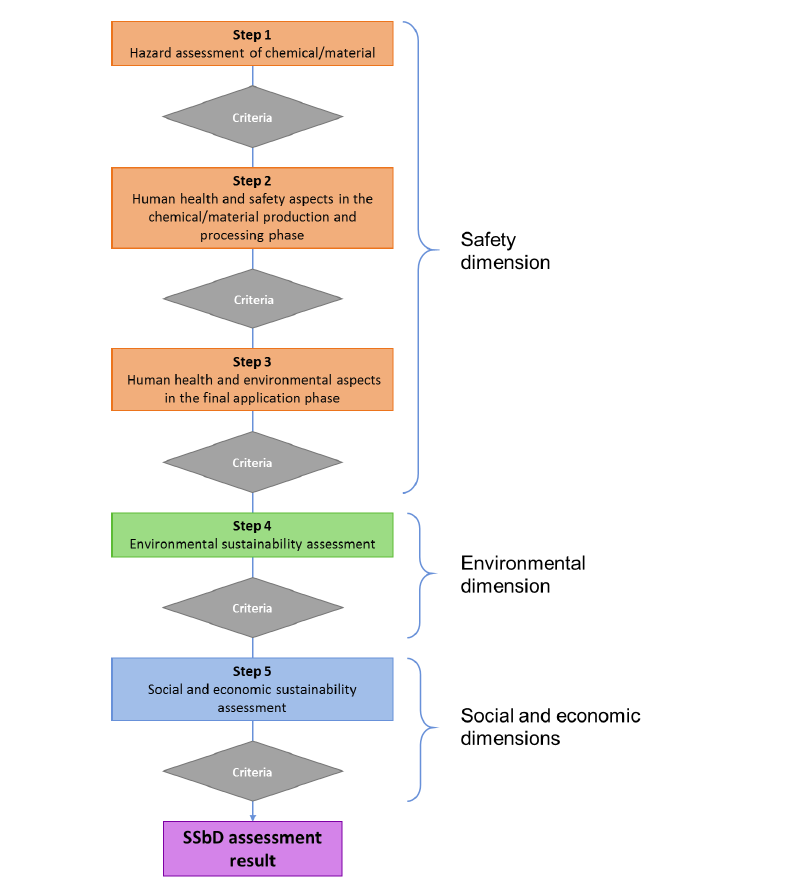
The development of the SSbD has been inherently iterative, starting from the official Commission Recommendation in 2022, followed by practical case studies testing the framework in 2023, resulting in an additional methodological guidance document in 2024, including a more practical toolbox. After multiple iterations with a wide variety of stakeholders, workshops, and a feedback process, the European Commission is aiming to update the methodology by the end of 2025.
Navigating the SSdB in practice
For many companies, applying the SSbD can feel challenging for multiple reasons. One of those can be the rather low data availability in the chemical sector, specifically for novel innovations at a low technology readiness level, while simultaneously requiring cross-department expertise, collaboration, and resources.
Start your SSdB journey with PRé
At PRé, we believe the shift from reactive to proactive requires a new mindset, methods, and capabilities to navigate those challenges. That’s why we’re offering hands-on SSbD trainings, helping teams build the skills and systems to embed sustainability at the early design stage. Through a customizable learning journey we support companies navigating the SSbD process. This can include:
Designing for a safer, sustainable future
The tailored SSbD learning journey has multiple advantages: from proactive risk reduction, over regulatory readiness and future-proofing, to innovation-driven sustainability. Additionally, it builds internal capacity at the company to navigate the increasingly blended spheres of R&D, regulatory compliance, and impact assessments. The developed PEF-like screening LCA model can be used as a basis and iteratively improved over time, as soon as the innovation develops further and more primary data becomes available.
In short, the SSbD empowers industry and researchers to develop products that are not only functional and competitive but also safer for people and the planet from the very beginning.
Are you interested in learning more about the Safe and Sustainable by Design framework, how it can benefit your case or company, or want to learn more about the use of LCA in the wider EU policy landscape?
Reach out to us to learn more about our service offerings tailored to your needs.
Marina Dumont
Sector Lead Medical & Pharma
We live in highly interconnected systems. By using science and tools, we can learn to understand the dynamics between those systems – and what we can improve and where to do better. I strongly believe that we need interdisciplinarity to solve today’s challenges: improve how we deal with our environment, and by that improve our economy and our society. We need to take responsibility into our hands and change the status quo.