

Important impact assessment developments of 2025
In 2025, the reality of climate change became even harder to ignore. From floods to storms and hurricanes, extreme weather underscored how closely sustainability and resilience are tied to economic stability. Across industries, LCA remained a trusted foundation for measuring and improving sustainability performance. New life cycle impact assessment (LCIA) methods and developments improved the holistic assessment of complex environmental challenges by increasing the precision and completeness of sustainability metrics. This article highlights notable LCIA developments published in 2025, reflecting how the field is evolving toward clearer, more actionable insights. It was written by Eline Willems and Laura Schumacher with contributions from Anne-Marie Boulay, Till Bachmann, Valerio Barbarossa, Edgar Sergues, Anne van den Oever, Rosalie van Zelm, Pascal Piveteau and Mikolaj Owsianiak.
We begin by presenting the updated and newly generated characterization factors (CFs) for different environmental impact categories, organized by the environmental compartment in which the impacts occur. This year, many methodological developments have focused on aquatic ecosystems, leading to significant updates in this area. Later in this article, we will describe other methodological improvements and developments that were made this year.
Characterization factor (CFs) generation and updates
Aquatic ecosystems
Marine impacts of synthetic and cellulosic microfibers
Building on earlier work, the MarILCA working group further improved how to assess the environmental impacts of plastic litter through LCIA. Two major updates were done in 2025:
- Microplastics: The research described in our previous article regarding microplastics is now integrated into leading LCIA models, including GLAM, IMPACT World+, and the Product Environmental Footprint Category Rules (PEFCR) for the apparel and footwear sector. The research was published in the Journal of Cleaner Production.
- Cellulosic microfibers: A complementary study applied the methodology for microplastics to develop CFs for cellulosic microfibers, such as cotton and viscose. This enables a more consistent comparison of the environmental impacts of synthetic versus natural fibers. When tested in case studies of textiles, the results showed that microfibers released during the life cycle of synthetic garments can significantly contribute to ecosystem quality impacts. In contrast, emissions of cellulosic fibers were found to have a much smaller impact. The study providing CFs for cellulosic microfiber study is currently under peer review but is already available as a preprint.
Ongoing efforts aim to further refine these CFs by incorporating multimedia fate and effects modeling across all ecosystems: terrestrial, freshwater, and marine. This work will help create a more comprehensive and scientifically robust foundation for assessing the environmental fate of plastic litter.

Freshwater ecotoxicity impacts of pharmaceuticals
A new study conducted by researchers from the Radboud University of Nijmegen addresses a major gap in LCIA by developing CFs for assessing the freshwater ecotoxicity of pharmaceuticals. Pharmaceutical residues have become a growing concern in aquatic environments, and although the pharma sector is making great progress with regards to methodological alignment, the impacts of pharmaceuticals are often underestimated in LCIA due to missing CFs.
To close this gap, the researchers derived 292 new CFs for pharmaceuticals, significantly expanding the number of substances that can be included in ecotoxicological impact assessments. The results show that pharmaceuticals with highly specific modes of action and high toxic potency exhibit the highest CFs.
Through a case study, the researchers demonstrated a sevenfold increase in freshwater ecotoxicity impact scores when using the newly derived CFs compared to those currently available in USEtox. This represents an important advancement: pharmaceuticals previously lacking CFs would otherwise appear to have no toxic impact in LCA studies. By enabling the evaluation of ecotoxicity impacts from pharmaceutical emissions, particularly during end-of-life stages, this work supports more comprehensive and accurate LCAs in the healthcare sector.
The study is currently submitted as part of the EU Horizon project TransPharm.

Benthic marine biodiversity impacts of offshore wind farms
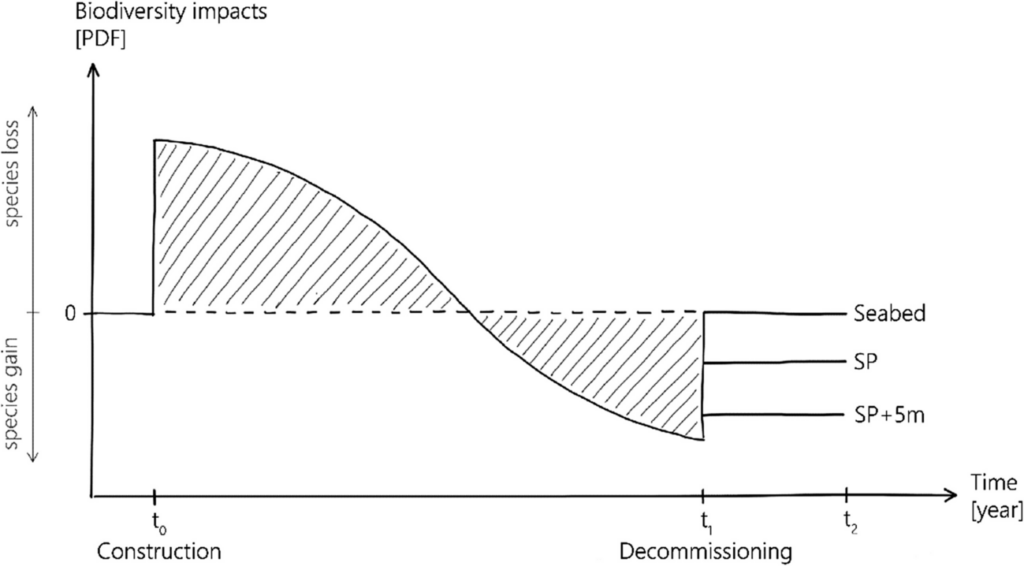
As offshore wind energy continues to expand, assessing its environmental effects is becoming increasingly important. Researchers from DTU and NTNU have developed the first CFs to assess how offshore wind farm construction and decommissioning affect benthic marine biodiversity (species at the bottom of the sea) both positively and negatively.
Using over 3,500 samples from 17 artificial structures – man-made reference seabeds – in the North Sea, the study modelled changes in species richness over time and derived life cycle-based biodiversity impact factors. The results show that species richness on offshore structures generally increases as they age, but the overall effects depend on seabed type and decommissioning strategy.
This new method allows LCA practitioners to capture both positive and negative biodiversity impacts of offshore energy infrastructure, supporting more informed sustainability assessments of renewable energy systems.
More details can be found in the published article.
Fish biodiversity impacts of freshwater fragmentation caused by dams
A new study by researchers from NTNU, CML and PBL quantifies how dams fragment freshwater ecosystems and affect fish biodiversity, filling an important gap in current LCA frameworks. The researchers developed global CFs to assess the isolation risk of 7,369 fish species affected by 31,870 dams worldwide.
Results show that, in general, dams for hydropower cause higher fragmentation impacts than those for irrigation, with strong spatial variation across regions. Case studies show the method in practice and illustrate the relevance of including freshwater fragmentation in LCA.

Atmospheric ecosystems
Ozone depletion impacts of various substances
A recent collaborative publication of Van den Oever and others provided updated CFs for ozone depletion, based on the most recent ozone depletion potentials (ODPs) from the 2022 World Meteorological Organization (WMO) Scientific Assessment.
The new dataset includes CFs for both 100-year and infinite time horizons and covers all 318 substances listed in the WMO 2022 report, making it the most comprehensive and up-to-date LCIA dataset for ozone depletion available today.
This update enhances the relevance of ozone depletion assessment in LCA, covering not only substances currently in use but also those that are banned yet persistent in the atmosphere, as well as very short-lived substances and nitrous oxide (N₂O).
To support practical application, the dataset is formatted for easy import into major LCA tools such as SimaPro.
Terrestrial ecosystems
Impacts of pathogens
Researchers from INRAE have developed a new LCA impact category called microbial pathogen potential. This work serves as a proof of concept for calculating the health impacts of pathogens released into the environment, supported by newly constructed CFs. The study, done on data from mainland France, focuses on the Listeria monocytogenes bacterium, which can enter agricultural soils through the spreading of organic fertilizers.
For this CF, the fate factor was modelled at the level of individual agricultural plots to account for soil conditions and physical characteristics influencing pathogen persistence. Dietary data from the INCA3 national nutrition survey were used to estimate the exposure factor for cheese consumption, while the effect factor reflects the probability of disease in vulnerable populations.
Although this proof of concept focuses on a single pathogen and a specific exposure pathway, it lays a methodological foundation for broader application. Expanding this approach to other pathogens, food types, and environmental compartments could significantly improve the way human health impacts are assessed in LCA, an important step toward understanding and managing the health dimensions of sustainable food systems.
This study is submitted to the International Journal of Life Cycle Assessment and is currently under review.

Other methodological improvements and developments
Effectiveness of regionalization in Arctic regions
A new study explores how regionalized LCIA methods can improve the accuracy of environmental results in Arctic regions. Conducted by researchers from the University of Sherbrooke and Université Laval, the work focuses on the Nunavik region in northern Québec, Canada.
The team used the Impact World+ methodology to develop regionalized CFs for 11 midpoint impact categories, ensuring consistent spatial resolution across the Arctic context. These regionalized CFs were then compared to global averages and country-level values in two case studies – on electricity production and heat generation – to assess their influence on LCIA results.
The findings show that country-specific data generally provide more accurate results than global averages in Arctic conditions. However, LCA practitioners should be aware that some models are not yet mature enough to fully capture Arctic-specific environmental dynamics. Using a regional resolution may alter conclusions in regions with low population density, because this may affect models that account for human interventions.

Quantifying carbon loss from plastics
Carbon resource dissipation is the irreversible loss of carbon as a usable resource, typically when it becomes dispersed as CO₂ or other forms that cannot be recovered. It reflects how human activities ‘use up’ carbon in ways that prevent it from being cycled or reused in natural systems. Models for a similar phenomenon, metal resource dissipation, have advanced in recent years, but equivalent methods for carbon-based materials (such as plastics) have lagged behind. A new approach by researchers from DTU builds on carbon chemistry and the thermodynamics of chemical recycling to monomers to identify dissipative forms of carbon embedded in plastic polymers.
The method provides a first step toward a systematic framework for assessing carbon resource dissipation. This will help align environmental sustainability assessments for products made from both metals and carbon-based materials.
Read the full study: International Journal of Life Cycle Assessment
A stepwise approach for LCIA
A new publication by Van Zelm and others presents a clear, stepwise approach for performing LCIA using the ReCiPe midpoint and endpoint method. This approach helps practitioners identify the most meaningful LCA results and verify their robustness across different impact categories and perspectives.
The authors recommend including all three endpoint categories (human health, ecosystem quality, and resource availability) and all three perspectives (individualist, hierarchist, and egalitarian) at the start of any assessment. They also propose a midpoint-to-endpoint contribution analysis to reveal which midpoint impacts generally drive overall results.
This approach delivers balanced insights, avoids burden shifting, and gives you a solid, science-based basis for communicating sustainability results.
Biodiversity loss from mixed chemical pollution
Chemical pollution is a leading cause of biodiversity decline. Yet, understanding and assessing the combined effect of multiple chemicals has been a long-standing challenge. Researchers at DTU and RIVM developed a new framework linking the predicted ‘mixed toxic pressure’ of chemical pollutants to observed biodiversity loss in freshwater ecosystems. Using extensive Dutch monitoring data, the team found an almost 1:1 relationship between chemical mixture pressure and species loss. This provides a strong empirical basis for assessing biodiversity impacts and helps define a science-based ‘safe operating space’ for chemical pollution.
Read the full study: Global Change Biology
A comprehensive approach to life cycle costing for sustainability assessments
A new study as part of the ORIENTING project presents a comprehensive life cycle costing (LCC) methodology designed to strengthen the economic dimension of life cycle sustainability assessment (LCSA). LCSA is the evaluation of environmental, social, and economic impacts, by combining environmental LCA, LCC and social LCA. Existing LCSA approaches often lack consistency and practical tools, so the researchers developed a robust framework applicable to any product type. They tested it in two real-world case studies: a beverage carton and an wool outdoor jacket.
The framework aligns with environmental LCSA principles, avoids double counting, and can accommodate different stakeholder perspectives and externalities. It also offers practical guidance on data collection, cost allocation, and reporting, with flexibility to adapt economic indicators depending on the goals and scope of a study.
The case studies demonstrate how the method quantifies total costs and value while addressing challenges such as data confidentiality. This new approach provides a clear structure for integrating economic analysis within sustainability assessments, though further progress is needed on data quality and transparency.
The study is published in the International Journal of Life Cycle Assessment.
Eline Willems
Sector Lead Chemicals
To make the world a better place we need to face sustainability challenges. Providing data-based solutions will help to make better decisions in the future and take on these challenges. I want to be a part of this journey.
Laura Schumacher
Expert
The current human influence on earth systems is unsustainable. To lower this impact it needs to be understood first. Working in sustainability metrics combines my passion for modelling and understanding human influence with my drive to lower the environmental impact of daily practices.